Measuring with Nonstandard Units (And Why the Ruler Can Wait)
Measuring with nonstandard units helps students understand units, iteration, and length before rulers. Learn what to watch for, and when the ruler can wait.
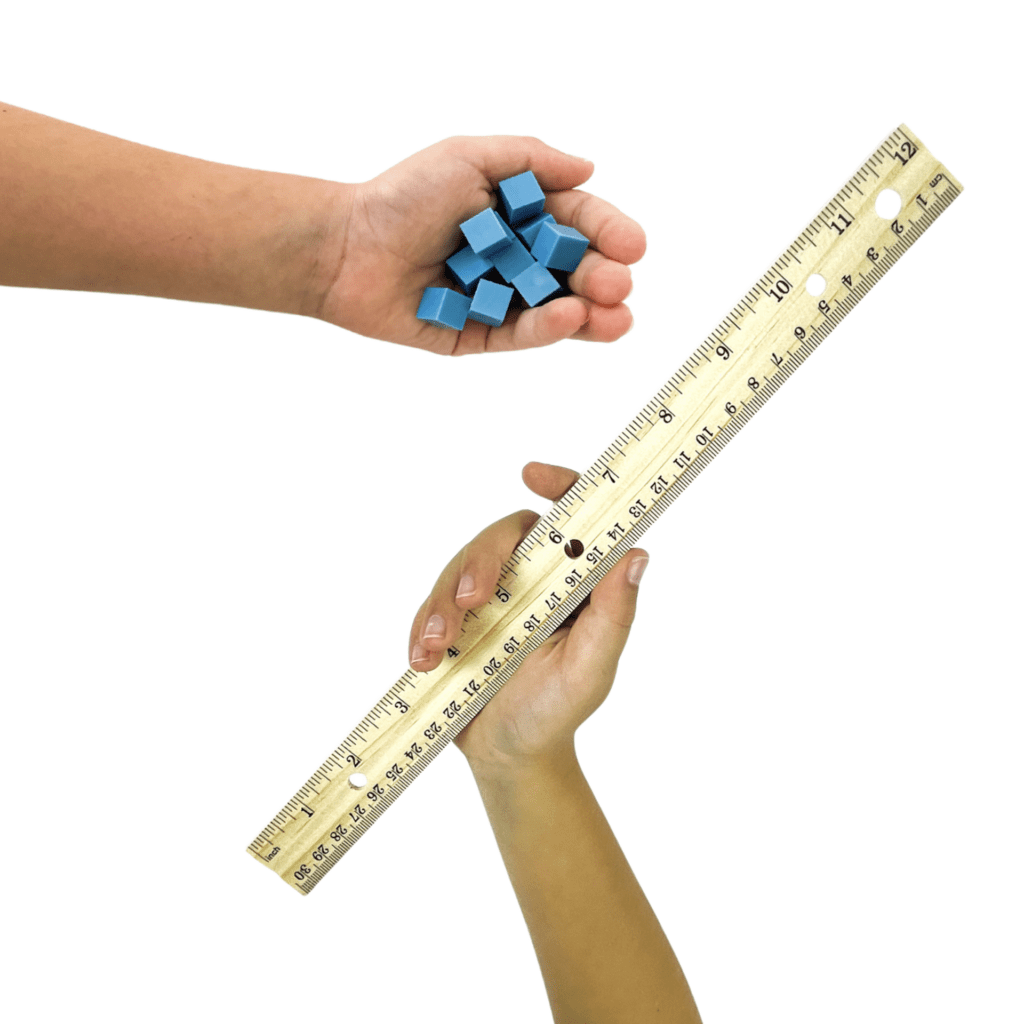

You’re already doing the right things. I know you are! You’ve got your connecting cubes out, your paper clips ready, maybe even counting bears and dominoes. You’re teaching measuring with nonstandard units, following best practices, and feeling good about it.
But here is the question I didn’t realize I needed to be asking: Do we know WHY we’re doing it?
The truth is, I used to think measuring with nonstandard units was just a warm-up. I saw it as a way to get students comfortable with the PROCESS of measuring before we introduced the “real” tool: the ruler.
Turns out, when students are measuring with nonstandard units, they are building three really important mathematical understandings about what measurement actually is.
And once I truly saw that, I started wishing I had waited a little longer before handing out rulers.
What the Ruler Can Hide
Let me paint you a familiar picture. Your student measures a pencil with a ruler. They line up the zero perfectly. They read “5 inches.” Gold star, right?
But if we asked them why that pencil is five inches long…we might get a shrug, or a “Because that’s what the ruler says” kind of response.
Rulers are powerful tools, but they’re also incredibly abstract. They quietly assume students already understand what attribute they are measuring, what a unit of length is, how units accumulate, what the tick marks and numbers mean…you get the picture.
That’s a lot of understanding to assume.
Without that foundation, students learn to use rulers mechanically. They follow steps, but the mathematics underneath stays hidden. That’s why measuring with nonstandard units matters. Nonstandard units are the foundation that makes rulers (and all future measurement) make sense.
Let’s unpack the three mathematical understandings that measuring with nonstandard units is developing.
Understanding #1: What IS a Unit?
Let’s start with something that sounds simple but absolutely isn’t for young learners: What IS a unit?
Mathematically, a length unit is a defined amount of space that we use for comparison. When we say something is “5 units long,” we mean that five equal-sized spaces, placed end-to-end, span the entire length.
This means measurement is fundamentally about the ACCUMULATION of space, not counting objects.
Think about that distinction. We’re not asking “how many cubes touch this pencil?” We’re asking “how much space does this pencil take up when we measure it using this particular size of space?”
A Purposeful Mistake Worth Lingering On
One of my favorite ways to surface this idea is by making a very obvious mistake. I measure an object using nonstandard units, but I leave big gaps between them.
And every time, students rush to fix it. They’ll say things like, “No! You have to connect them!” or “You’re not measuring the whole thing!”
THIS is the moment. Don’t rush past it. Let them articulate WHY the gaps matter. This self-correction solidifies their understanding way more than us just telling them “you can’t have any gaps”.
(Side note: You can do the same thing with overlaps. Stack the units and let students explain why that doesn’t work either.)
If you want to see a great classroom example of this kind of thinking, this post on measuring length indirectly walks through how students’ strategies (including gaps, overlaps, and unit choice) reveal what they understand about units.
Understanding #2: From Filling to Iterating
Once students get what a unit is, something really interesting starts to happen.
At first, they need lots of physical units. Measuring 10 units? They want 10 cubes. Makes sense.
But gradually (and this happens at different speeds for different kids) they realize something. They don’t need 10 cubes. They can use one cube multiple times.
This is a MASSIVE conceptual leap. They’re understanding that:
- The cube represents a size of space (the unit)
- That size stays the same when the cube moves
- They can “reuse” that unit over and over
- They need a way to track where each iteration happened
This progression from concrete to abstract mirrors huge ideas in mathematical thinking. At the concrete level, students are dealing with discrete objects (many individual cubes). As they develop iteration, they’re moving toward understanding measurement as continuous quantity (accumulated space) while using discrete markers (the cube they move, the marks they make) to track that continuous accumulation.
This is sophisticated! They’re holding two ideas simultaneously: the individual iterations AND the total accumulated length.
Give students freedom in how they approach measuring with nonstandard units, and you’ll see this progression:
- Some cover the entire length with units (concrete, all units visible)
- Some use a few units and move them sequentially, tracking mentally (emerging iteration)
- Some use one unit and mark each position (iteration with physical tracking)
- Some mark positions with numbers showing cumulative total (abstraction toward ruler-like thinking)
All of these are mathematically valid, and all of them give you information about where each student is in their conceptual development.
Pro tip: If you’re noticing a student who’s still filling the entire length while most of the class has moved to iteration, that’s your signal that they need more time and practice with the concrete units. Don’t rush them to the ruler!
Why This Matters for Rulers
Here’s the big connection: a ruler IS iteration. Someone has already repeated a one-unit space over and over, marked where each repetition ends, and labeled how many units have accumulated.
When students have experienced iteration themselves, they look at a ruler and think, “Oh, this is what I have been doing, except much faster!”
When they haven’t, they follow procedures without understanding the mathematical meaning.
Understanding #3 – Conservation of Length
This last concept surprised me the most as a teacher.
Conservation of length means understanding that a length stays the same even when its appearance changes.
A zigzag path can be the same length as a straight one. A string measures the same whether it’s stretched or curved.
To adults, this feels obvious. To children, it often isn’t.
What This Looks Like in the Classroom
I like to create several paths that all measure the same length but look completely different: one straight, one zigzag, and one curve.
Before measuring, I ask students to predict which path is longest. Most of them pick based on how the path looks. They’ll say things like, “The zigzag one is shorter because it goes back and forth” or “The straight one has to be longest because it doesn’t bend.”
Then we measure.
Students experience a productive tension between what their eyes tell them and what measurement proves. They begin to understand that measurement is:
- Objective (not dependent on how things appear)
- Precise (gives exact comparison)
- Reliable (the same length will always measure the same)
- Transferable (we can compare lengths that look completely different)
Why This Is Mathematically Significant
Young students are learning that measurement is an invariant property meaning it doesn’t change based on orientation, arrangement, or configuration.
This is huge! It means measurement gives us information that our perception can’t always determine accurately. A bent path might LOOK shorter than a straight path, but measurement tells us they’re actually the same length.
So…When Are Students Ready for Rulers?
Here’s what I look for now.
Signs of Mathematical Readiness
- Students can explain (not just demonstrate) why units need to be placed end-to-end
- Some students have started marking or tracking iterations rather than needing all units present
- Students have measured things that look different but are the same length, and can explain that measurement “proves” they’re equal
Notice these are about UNDERSTANDING, not just proficiency with the procedure.
Making the Connection Explicit
When students are ready, I make the bridge to rulers explicit. I’ll have students examine a ruler alongside their nonstandard units and ask questions like:
- “What do you notice about how this tool is marked?”
- “Where are the units on this ruler?”
- “Why do you think the numbers go up by ones?”
- “What do the spaces mean?”
- “How is this similar to what we’ve been doing?”
I want students to say, in their own words, that the ruler is doing the same work they’ve been doing.
Understanding vs. Procedure
I used to think measuring with nonstandard units was about building comfort and familiarity before the “real” measurement with rulers.
Now I understand it completely differently. Measuring with nonstandard units builds three important mathematical understandings:
- What units ARE (defined spaces that accumulate with no gaps or overlaps)
- How iteration works (moving from concrete objects to abstract representation)
- What measurement captures (invariant length, regardless of appearance)
When we rush this stage, we get students who can use rulers but don’t understand measurement. When we invest the time here, we get students who are powerful mathematical thinkers about length, space, and quantity.
So the next time you’re planning your measurement unit, give yourself permission to stay with nonstandard units longer. Watch for the mathematical understanding developing. Ask questions that surface thinking, and let students work through confusions and misconceptions.
The time you invest here is the real measurement work!