Keeping Things Fresh in Your Math Block (Without Adding More to Your Plate)
Every teacher has a running list. Maybe yours is a mental list, maybe it lives in a bookmarked folder or a stack of notes from the last PD you attended.
Every teacher has a running list. Maybe yours is a mental list, maybe it lives in a bookmarked folder or a stack of notes from the last PD you attended. You know what I am talking about! It’s the list of things you want to try. Practices that sound promising. Ideas that clicked when you heard about them. Approaches that feel like they’d be great for your students.
And yet most of those ideas stay on the list. Not because you don’t believe in them, but because your math block already has a shape to it. You’ve got enough things going on. Your students know what to expect. Your pacing is tight. And the thought of squeezing in something new raises the question you’ve probably asked yourself more than once: what would I take out to make room for it?
I think there might be a more helpful way to think about it. In most classrooms, the time for something meaningful is already there, sitting inside the structures your students already know. It’s really about looking at that time with fresh eyes and asking what’s possible inside it.
You Don’t Have to Choose Between Your Curriculum and Good Ideas
There’s a belief that lives quietly (and sometimes not so quietly) in a lot of schools, and it goes something like this: being faithful to your curriculum means delivering it exactly as written. (Does the phrase “with fidelity” ring a bell?) The message is don’t adjust, don’t add, don’t rearrange. Just follow the plan.
It’s an understandable belief, especially in districts where curriculum decisions are closely watched. But research on how curricula actually work best paints a more nuanced picture. The materials you use were designed with goals in mind, a learning trajectory, a set of mathematical ideas, and a vision for how students would engage with those ideas over time. Honoring that vision sometimes means making thoughtful adjustments based on what your students need. A teacher who responds to what she’s seeing in her classroom and adapts accordingly is doing exactly what good implementation looks like.
What matters is the nature of the adjustment. Skipping lessons in a carefully built sequence or removing key components can undermine what the materials are trying to build, and that’s not a good thing! But adding a brief routine that warms up mathematical thinking before a lesson, or building in a regular moment for students to learn from each other’s mistakes, supports those same goals. Think of it as working with the design, not against it.
When you do, the question to ask yourself shifts from, “Am I allowed to change anything?” to, “Does this support the kind of mathematical thinking my curriculum is trying to develop?” When the answer is yes, you’re breathing life into your materials.
The Power of Routines
This might be the least flashy advice in this entire post, but I think it’s the most important: if you want to bring more depth, richness, and freshness to your students’ mathematical experiences, do it through a routine they could do in their sleep.
I know, I know! That sounds counterintuitive! We tend to associate freshness with novelty, new activities, new formats, and new ways of organizing the class. I’m not saying don’t ever do new things with your students, but I am saying don’t feel like the key to keeping things fresh is having to mix things up ALL. THE. TIME.
Think about what happens when you introduce something unfamiliar. Students spend the first several minutes figuring out the logistics. What are we doing? Where do I write my answer? Am I working alone or with someone? That’s mental energy they’re spending on the activity format instead of on the math.
Now think about a routine your students have done dozens of times. They know the structure and what’s expected, and they settle in immediately. And because they’re not spending mental energy on figuring out the format, all of that brainpower goes straight toward the mathematical thinking. That’s where the freshness actually lives. The routine is the container, and what you put inside it each day is where you get to be creative, try new things, and have fun with the math.
Two routines that live in this sweet spot especially well are Number Talks and My Favorite Mistake.
Number Talks
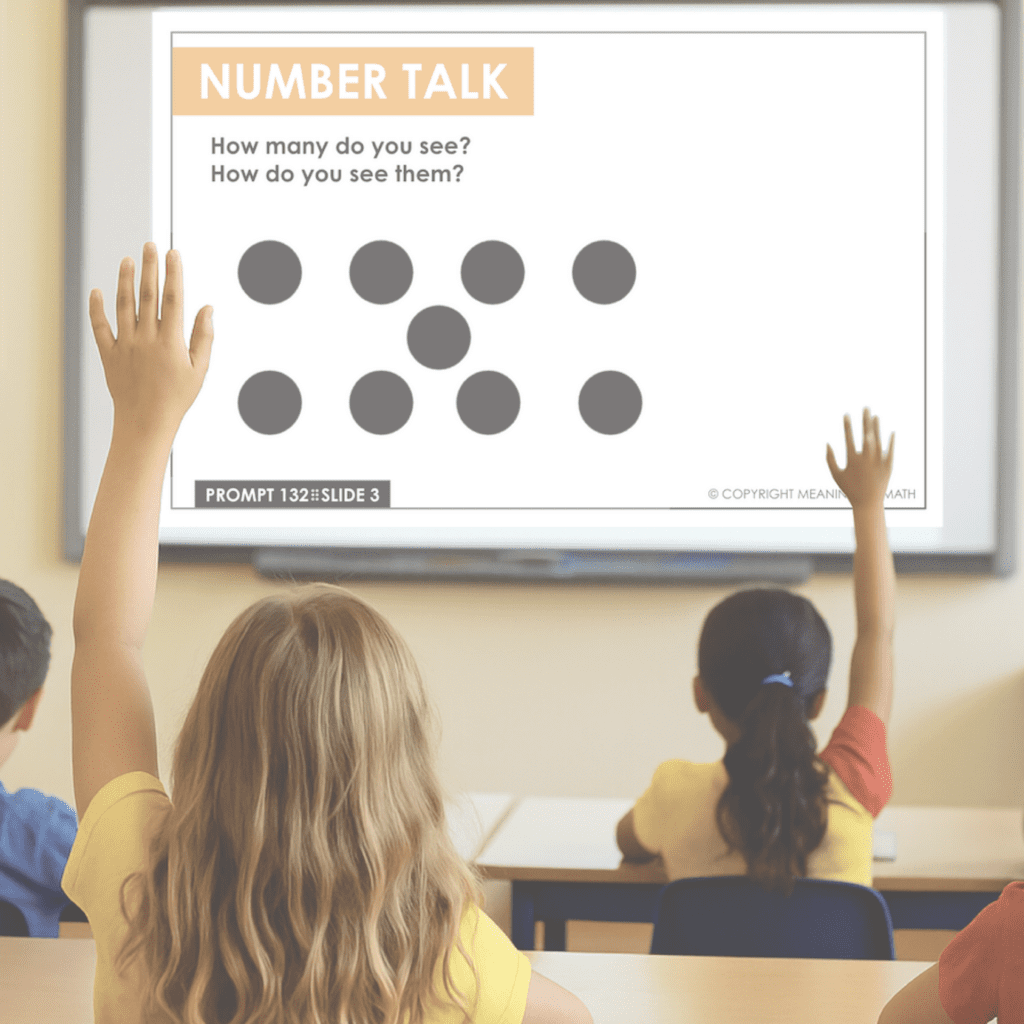
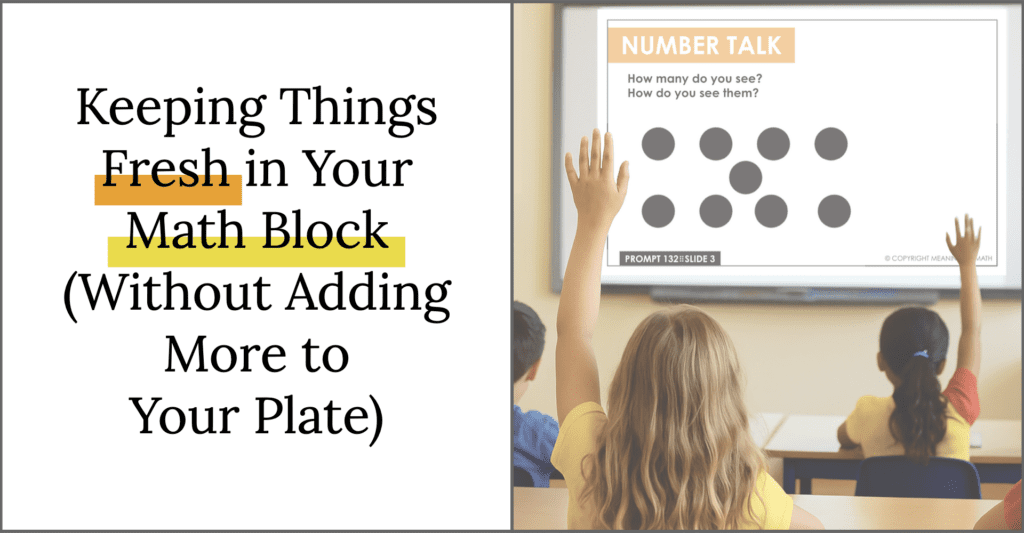
A Number Talk is a short, focused conversation built around a computation problem that students solve mentally. You present a problem, give students time to think, and then facilitate a discussion where multiple strategies are shared, compared, and connected.
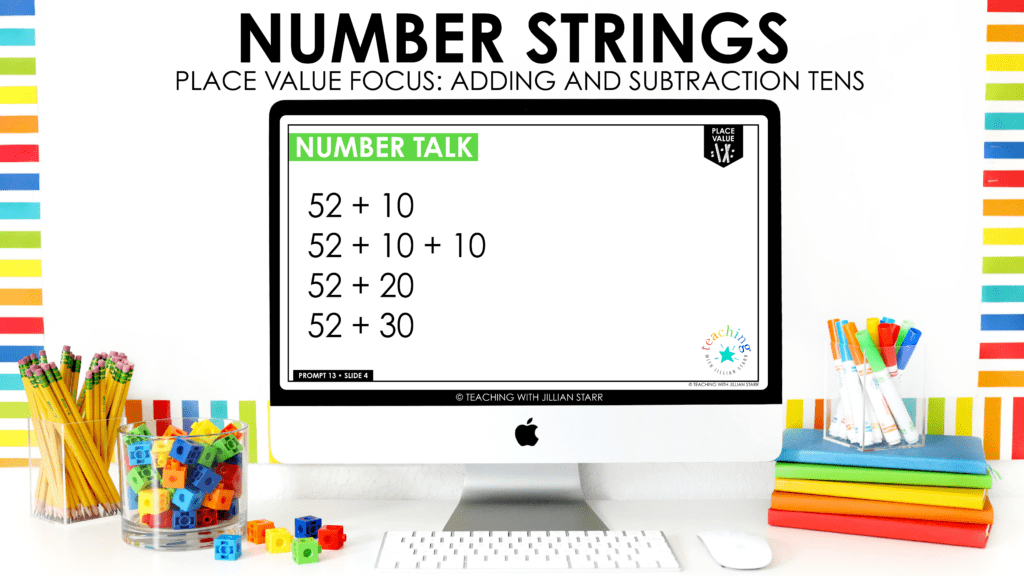
What I love about Number Talks is how much mathematical work they make possible in such a small window of time. When students solve a problem in their head, they have to reason about number relationships, make decisions about what strategy to use, and articulate why their approach makes sense. And when you record their strategies on the board and ask the class to think about how those strategies are related, the conversation moves into the kind of mathematical territory that really builds understanding.
Studies at the elementary level have found that students who participate in regular Number Talks become more flexible in how they work with numbers. They develop a broader set of strategies and they get better at choosing efficient ones.
That tracks with what we know more broadly about how computational fluency develops. The studies are small in scale, but the patterns are consistent, and what they describe aligns with well-established principles about how students develop computational fluency through understanding rather than just repetition.
From a practical standpoint, Number Talks fit naturally into the opening minutes of a math block. Most teachers already have some kind of warm-up in that window, and a Number Talk can live right there. Once students learn the format, (and they learn it fast), you’re not spending time on setup or directions. You’re spending every minute on the math. And because the problem changes every day, the thinking your students do is always evolving, even though the routine itself stays exactly the same.
If you’re looking to get started, I have Number Talks (and Math Talks) resources built around this kind of daily reasoning work.
My Favorite Mistake
If Number Talks give students a place to share and compare their reasoning, My Favorite Mistake gives them a place to examine where reasoning breaks down, and to see that that is actually where some of the most interesting mathematical thinking is happening.
Here’s how it works. You give students a problem to solve on their own. You collect their work, look through it quickly, and find one wrong answer that’s worth examining. Maybe it shows a common misconception. Maybe the student did a lot of things right but made one key misstep that reveals something important about how they’re understanding the math. You share that response with the class anonymously, and you facilitate a discussion that starts with what the student did well before looking at where things went off course and why.
The whole thing takes about five minutes, but what it does for your classroom culture, and for student learning over time is significant.
Think about how mistakes typically get handled in math. In most classrooms, wrong answers get corrected and everyone moves on. There’s nothing malicious about that. It’s just what happens when time is short and there’s content to cover. But think about what message that sends. If the only thing that happens when you make a mistake is that someone fixes it and the lesson keeps going, students learn pretty quickly that errors are things to avoid, or at least to keep quiet about.
Research tells us that the opposite approach is actually more productive. Studies on what happens when students grapple with problems and make mistakes before receiving instruction have found that those students develop a deeper grasp of the underlying math than students who get the instruction upfront. Both groups tend to perform similarly on procedural tasks, but the students who wrestled with mistakes showed a stronger grasp of the underlying ideas.
There’s also neuroscience research showing that when a person makes an error, the brain produces increased electrical activity, a response that happens whether or not the person is even aware of the mistake. When they do become aware of it and attend to it deliberately, a second neural response occurs. Both represent moments of heightened learning potential.
My Favorite Mistake puts those moments at the center of the conversation. And over time, it shifts how students relate to their own mathematical thinking. Instead of something embarrassing, a mistake becomes something worth looking at. They start to see that a wrong answer can contain a lot of right thinking, and that figuring out where things went off track is real mathematical work. That kind of relationship with mistakes is one of the most important things you can build in young mathematicians.
And just like Number Talks, the routine stays the same while the content changes every day. Your students’ own thinking is the material you’re working with, which means it’s never stale.
You Already Have Room for This
Neither of these routines asks you to reinvent your math block, or change your curriculum. They fit into time you already have. They support the same mathematical goals your curriculum is working toward. And because their structures are predictable, your students settle into them quickly, which means you spend your time on the math rather than on logistics.
If you’ve been sitting on a list of things you want to try, this might be a good place to start. Pick one. Try it for a couple of weeks. See what you notice about your students’ thinking and about the energy in your classroom during those few minutes each day.
The bottom line is that the kind of freshness that actually makes a difference in a math classroom doesn’t come from constantly changing things up. It comes from creating a steady space where mathematical thinking can grow. Students know what to expect, they feel safe to take risks, and the math is a little different every day, even when the routine isn’t.