Math Bulletin Board Ideas: Show How Math Grows Across K-3
Looking for math bulletin board ideas? Create a progression display showing how student thinking develops across K-3. Includes examples and implementation tips.
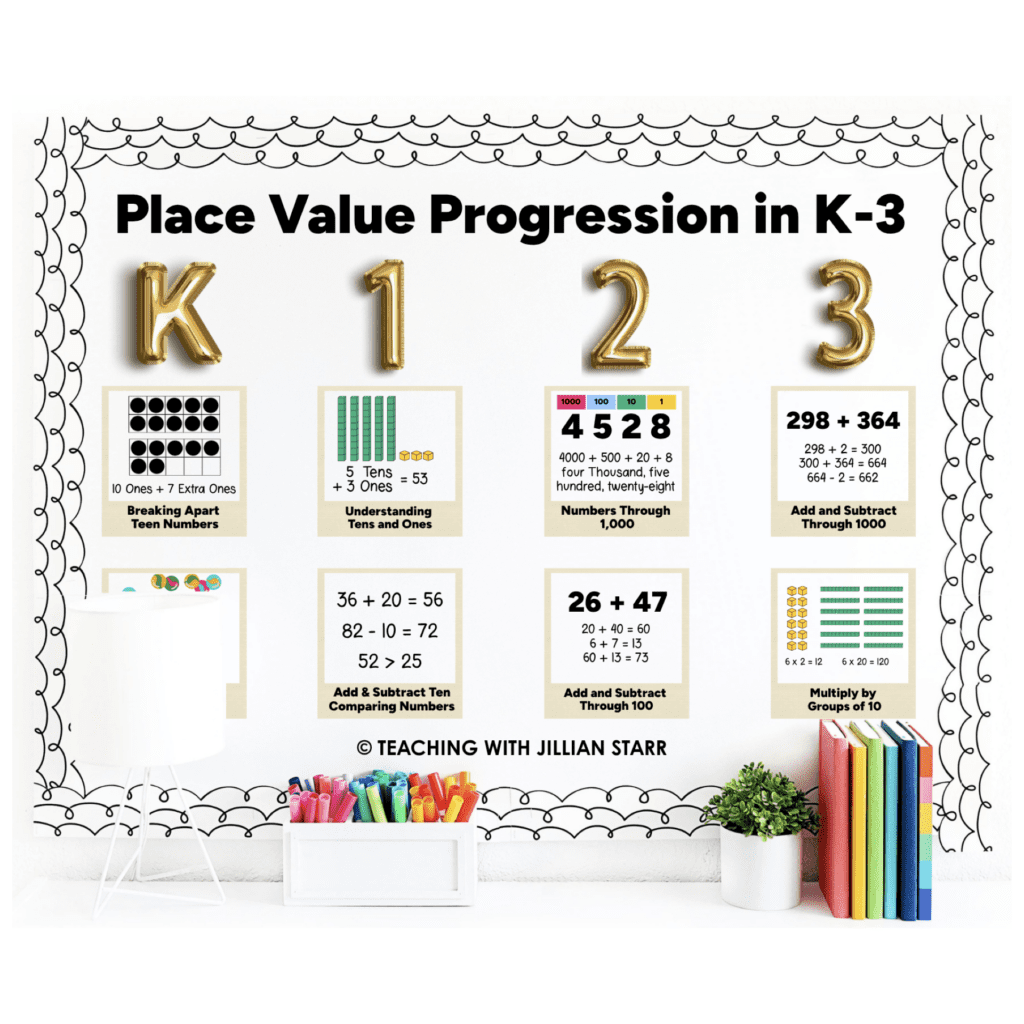

If you’re like me, you’re always looking for math bulletin board ideas that go beyond the usual displays. I mean, who out there doesn’t love putting together a great bulletin board? Whether you’re displaying student work, providing visual references, or just celebrating learning, they’re part of the fabric of elementary classrooms.
But here’s a math bulletin board idea I think you’re going to LOVE: showing how mathematical thinking develops across grade levels.
You read that right! Instead of just showcasing your current students’ work, what if you created a progression bulletin board with student work from multiple grade levels? Each grade contributes work that shows how mathematical strategies and thinking evolve. It’s one of my favorite math bulletin board ideas because it benefits everyone: teachers, students, and your whole school community.
Why This Matters
For teachers, these math bulletin board ideas reveal things you just don’t get from curriculum guides or standards documents. A second grade teacher might notice that first graders are already using number lines for addition and subtraction. Game changer! Or a kindergarten teacher sees first graders writing equations with their drawings and thinks, “I can start preparing my students for that.”
This type of display also answers those practical questions we all have. “What strategies did my students use last year?” and “What do they need to be ready for next year?” Instead of guessing, you can actually see where students are in their thinking.
For students, this makes the “Why are we learning this?” question so much easier to answer. A first grader working on making ten can see third graders using that same strategy to solve bigger problems. Mind = blown.
Younger students get curious too. They stop at the board and ask, “When do I get to do that?” (Love those moments!) Older students look back and recognize their own growth: “I remember when we only worked with numbers up to 20, and now I add three-digit numbers!”
For your school, the bulletin board starts conversations. Teachers notice things they wouldn’t have otherwise. “I didn’t realize kindergarteners were already working with teen numbers that way.” Or, “That’s a strategy I’d love to try with my class.”
How to Create a Progression Bulletin Board
Okay, so you’re interested! I won’t lie…this takes some coordination. You’ll need to work with teachers across grade levels and plan ahead for collecting student work. But the payoff is SO worth it.

Here’s how to make it happen:
Step 1: Choose Your Strand
Pick a mathematical concept that clearly develops across K-3. Addition and subtraction strategies work really well because you can see how problem-solving evolves. Plan it for later in the year when all grades have tackled some story problems.
(Other great options: place value, measurement, or geometry!)
Step 2: Decide on the Task or Focus
You have two options here:
- Use an open-ended prompt that works for all grade levels. For example, “How many ways can you show me 12?” You might see 12 objects drawn and counted, equations like 10+2, place value representations, or arrays and equations like 3×4=12.
- Pick a standard within your strand and have each grade tackle an age-appropriate task. For example, under Operations and Algebraic Thinking, each grade displays work from a story problem at their level. Kindergarten shows problems within 10, first grade within 20, second grade shows two-step problems within 100, and third grade tackles multi-step problems using all four operations.
Step 3: Collect Student Work
Chat with teachers at each grade level about what you’re creating. Ask them to save three to five samples that show a range of strategies. You want work that represents what students at that grade can actually do (not just the showcase pieces).
A quick tip: Games and center activities work great for this as long as students are recording their thinking! Recording sheets, work mats, or math journal entries from centers all show student strategies beautifully. (Need activities with recording components built in? Check out my Math centers bundles!)
Step 4: Organize the Display
Think about how you want viewers to experience the progression. Label each grade level clearly. Include the standard or skill focus if it helps provide context.
Adding a brief explanation at the top helps too: “Problem Solving Across Grades: How Addition and Subtraction Strategies Grow” or “Place Value Progression: Kindergarten Through Third Grade.”
Step 5: Use It as a Teaching Tool
Once your bulletin board is up, don’t just let it sit there! Bring your students to look at it. Ask questions like, “What do you notice about how kindergarteners solved this problem? How is that different from what third graders are doing?”
Invite teachers to spend time with it during planning periods or professional development. The board becomes most valuable when people actually engage with it.
Tips for Making This Work
Start small. You don’t need to create multiple progression boards at once. Pick one strand, one hallway, and see how it goes. You can always add more next year!
Get buy-in. Talk with grade level teams and see who’s interested. Explain the purpose and what you need from them. (Teachers are way more likely to participate when they understand the why behind it.)
Make it accessible. Put the display in a high-traffic area where students, teachers, and families will see it. Hallways near the office, cafeteria entrances, or main staircases work well.
Take photos. Document the board before you take it down. These photos are gold for professional development, curriculum planning, or explaining the concept to parents or new teachers.
Moving Forward with Math Bulletin Board Ideas
Progression bulletin boards take planning and coordination, but they create a shared understanding of how mathematical thinking develops across your school. Teachers gain insight into the full arc of learning. Students see themselves as part of a bigger mathematical journey. And your school community gets a tangible reminder that math builds over time.
If you’re looking for math bulletin board ideas that go beyond the typical displays, this is it! Pick a strand, gather your grade level teams, and give it a try. I can’t wait to hear what you notice when you put student work from all four grades side by side.