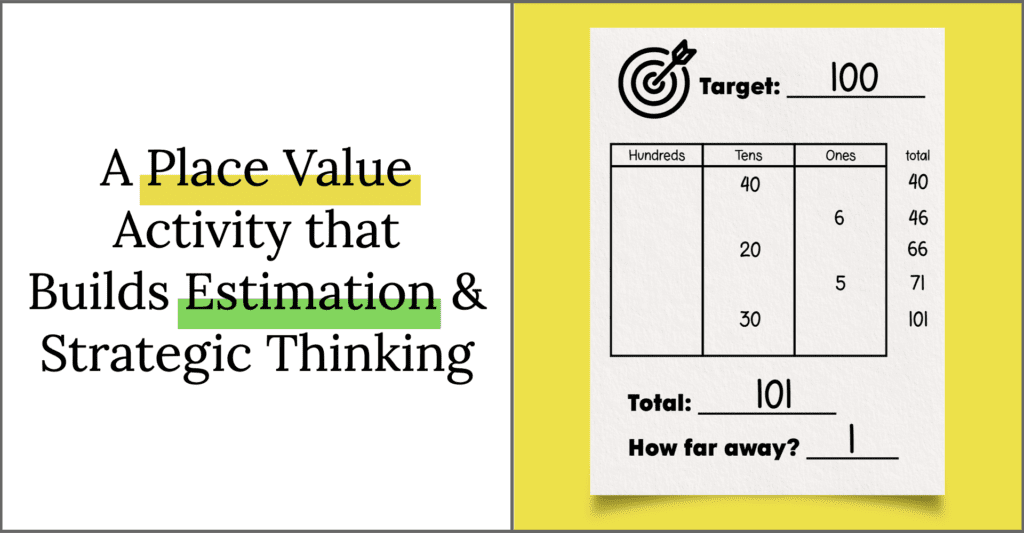
I’m always on the lookout for a great place value activity, and I definitely think this one is a keeper. It’s a dice game that puts estimation front and center. Students constantly estimate how close they are to a target number, then make strategic decisions about where each digit should go based on those estimates. And because chance is involved, every round feels different. Best part? It works across grade levels, and students absolutely love it!
Place Value Activity: How To
Materials: One die per pair, paper for recording (or prepared place value recording sheets)
The Setup
Start by choosing a challenge level. Decide on a target number (100, 500, 1000, etc.) and how many rolls each player gets. A good standard to go by: 5 rolls to reach 100, 8 rolls to reach 1000.
Students need a place value chart to record their digits. You can have them draw one quickly (just columns labeled ones, tens, hundreds, etc.) or prepare recording sheets ahead of time. For a target of 100, they’ll need ones, tens, and hundreds columns. For 1000? Add the thousands place!
The Game
Working in pairs, students take turns rolling the die. Here’s where it gets interesting. After each roll, they decide which place value column to put that digit in.
For example, a student rolls a 6. They can place it in the hundreds column (600), the tens column (60), or the ones column (6). Once they place a digit in a column, it stays there. They can’t move it later. After all their rolls, they add up their total.
The Goal
Get as close to the target number as possible.
Sample Round
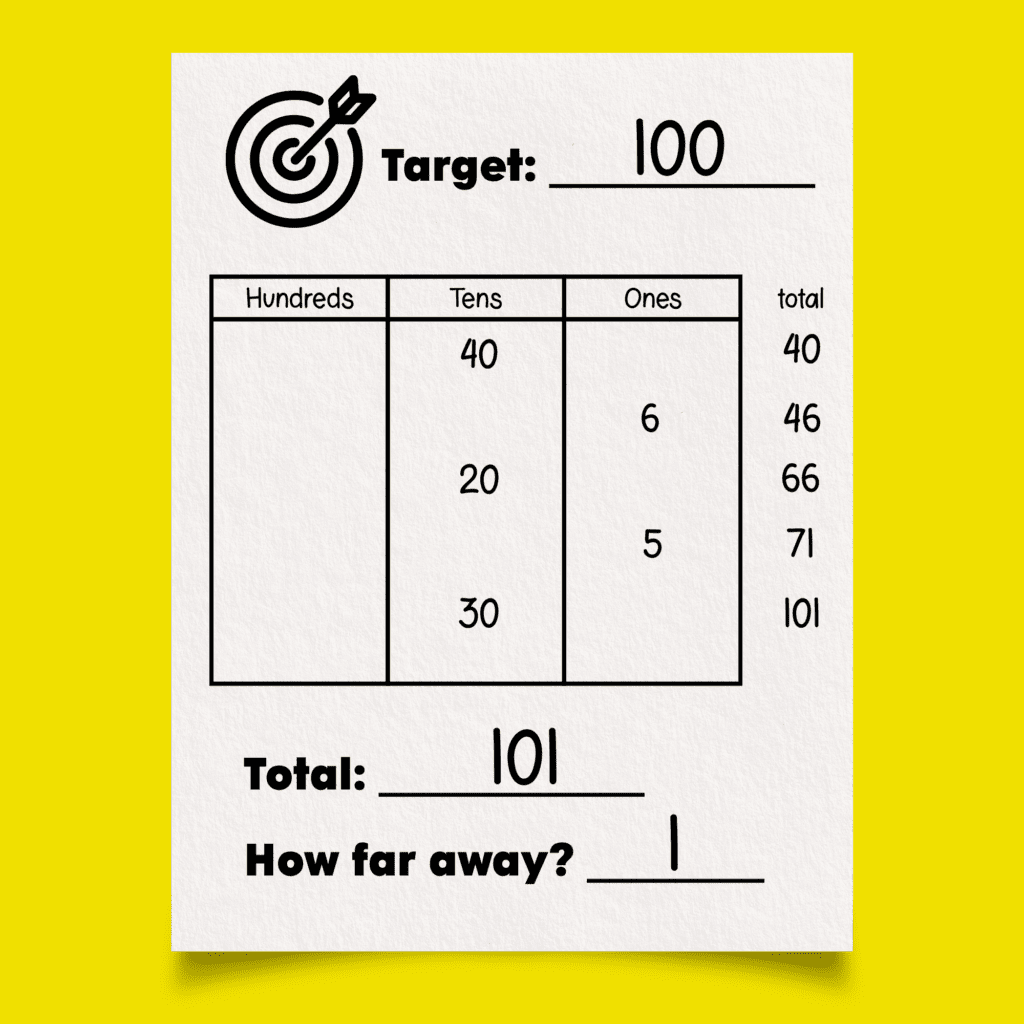
Here’s what a round looks like when aiming for 100 with 5 rolls:
Roll 1: I get a 4. I put it in the tens column (40). I’m estimating I need about 60 more to reach 100.
Roll 2: I get a 6. That’s high! If I put it in the tens column, I’m already at 100 and I still have 3 rolls left. I put it in the ones column (6) instead. Now I have 46.
Roll 3: I get a 2. I put it in the tens column (20). Now I have 66.
Roll 4: I get a 5. Hmm. If I put it in the tens column (50), that would put me at 116 – over my target! I put it in the ones column instead (5). Now I have 71.
Roll 5: I get a 3. I put it in the tens column (30). Final total: 101. I went over by just 1!
Why This Place Value Activity Checks All the Boxes
It Makes Estimation Concrete and Ongoing
Students aren’t just guessing once at the beginning whether a sum will be about 50 or about 100. They’re actively tracking where they are and constantly revising their estimates. “I have 46, I need about 50 more, and I have 3 rolls left.” This ongoing mental math is exactly the kind of number sense we want students to develop!
Place Value Becomes Strategic
In this place value activity, students are moving beyond “the 4 is in the tens place so it’s worth 40” to, “should I put this 4 in the tens place right now, or should I save that spot for a bigger number?” Students have to understand place value well enough to make strategic decisions about it in the moment.
There’s Genuine Mathematical Reasoning Happening
Students are grappling with mathematical reasoning with every roll. Should they put their first roll in the hundreds? Or wait and see what comes next? If they roll low numbers early, they might not reach their target. If they roll high numbers early, they might waste them in lower place values. Students are constantly weighing options and making choices based on probability and strategy. It’s really cool to watch!
Mistakes Become Powerful Learning Opportunities
When a student puts a 6 in the hundreds right away, then keeps rolling 5s and 6s and ends up blowing past the target, you’ve got a perfect teachable moment. Asking “What would you do differently next time?” leads to really rich conversations about strategy and place value.
Getting Started
I usually play a round with the whole class first. I’m the player, and students help me make decisions. “I rolled a 5. Where should I put it? Why?” This lets them see the strategic thinking involved before they play on their own.
I love doing a think-aloud as I make decisions: “Hmm, I rolled a 2. That’s pretty low. I don’t think I want to use my hundreds place for a 2, because if I get a 5 or 6 later, I’ll wish I had saved it!”
Once students understand the game, they are ready to play in pairs or small groups.
Grade Level Adjustments
One of the things I love about this game is how easily it scales:
Grades 1-2: Target 50 or 100 with 4-5 rolls.
Grades 2-3: Target 100, 200, or 500 with 5-7 rolls.
Grade 3+: Target 1000 with 7-8 rolls.
You can also adjust the challenge by adding in a “calculate how far away you are” when students have totaled up their values. I’m telling you, this place value activity is SO rich.
Discussion Questions That Deepen Thinking
After students play a few rounds of this place value activity, pause for a quick debrief. I like to ask questions that get them reflecting on their strategies. Here are some that work really well:
- Which place value column was most important to manage? Why?
- Did your strategy change from your first roll to your last roll?
- If you could go back and change one decision, which would it be? Why?
- Is there such a thing as a “good” first roll and a “not-so-good” first roll? If so, what are they and why?
- Is it better to fill your high place value columns (like hundreds) first, or start with the lower ones?
Some students will have strong opinions. Others will realize they haven’t been thinking strategically at all and they’ve just been placing numbers randomly. Both are valuable realizations!
What to Look For
Students who understand place value deeply will play strategically from the first roll. They’re thinking about the value of each place and making decisions accordingly.
Students who are still building that understanding will place numbers more randomly at first. But watch what happens! After a few games, they start noticing patterns, and pick up on strategies their partners are using. That’s the kind of discovery we love to see.
And watch for the post-game conversations, too. Students will want to defend their choices or explain where they went wrong. “I put a 3 in the hundreds too early and then I rolled a 6!” I love it when that kind of mathematical discourse flows naturally.
Making This Place Value Activity Part of Your Routine
This game works as a warm-up, a center activity, or something to pull out when you have 15 minutes to fill. Students can play it independently once they know the rules, which makes it perfect for choice time or early finishers.
Once your students know how to play, they’ll ask for it again and again! If you’re looking for more place value activities to mix things up, I’ve got you covered here.